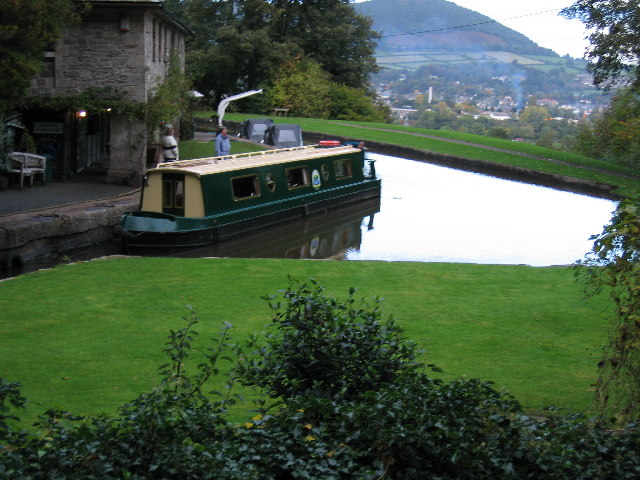
Hay view from Castle

Hay view from Castle
Hay-on-Wye, Powys (formerly Breconshire), Wales. The "Town of Books" (and Vaughans!)
Showing posts with label John Vaughan 1825. Show all posts

Sunday, September 2, 2018

A Visit to the Vaughan Home in Cusop, Church Cottage

Skipping dinner was no sacrifice for me. I had a car hire for just a few days. There was no gap in the tour schedule, so I just took off when I could. We were already in Merthyr, so I just headed over the Beacons past Brecon and on to the Wye, up the backside of Hay, and into Cusop Village.

The Cusop History Group had already provided some good evidence of the location of Cusop Green and the only house there in the 1830s is the only house there now, Church Cottage, across from the lower corner of St. Mary's churchyard. This is very likely where John and Elinor Vaughan lived in the 1810s-1820s. Several of their children were likely born there. Possibly, that included John Vaughan (1825) in my direct line of fathers' fathers.

Church Cottage, Cusop Green, Cusop, Herefordshire

Sunday, June 25, 2017

Jane Vaughan and John Lewis's Marriage Certificate

Now I have to go back and rewrite a couple of chapters!

Every piece of evidence brings more questions.

But this is so cool!

First of all, everything fits. The two fathers of bride and groom are right and (1789) John Vaughan's profession is butcher in 1846! This predates (1825) John Vaughan's 1846 marriage to Maranah Watkins by two months so it's OK for Jane Lewis as a witness at her brother's wedding to be using her married name!

Wednesday, March 22, 2017

Why Was John Vaughan (1825) in Abersychan in 1847?

Another serendipitous discovery as I was skimming through Welsh Historical Journals online, the simple answer being that 1846-47 were the years of highest pay for puddlers at the Abersychan Iron Works.

Friday, November 11, 2016

Historical Novels VERY Closely Related to Our Vaughan Family History


Roman Amphitheater, Caerleon, Newport, Wales, 16 July 2016 
Distancing myself from current politics into the old country and times past, I am rereading the historical novels of Alexander Cordel now that I have been to more of the places and learned a little better how they connect to my family.

Rape of the Fair Country carries the reader through a passionate narrative of the sorrows and joys of the working and non-working Welsh to the Chartist March on Newport. A foreshadowing is presented when the families of Garndyrus (where my Third-Great-Grandfather, John Vaughan 1825, worked) had a holiday in Newport for a singing competition. It's a fictional account. The later march on Newport was not.

I don't know if my family was involved in the Chartist Rising of 1839. Even if they were, and apparently survived, they would not have mentioned it to anyone as it carried a penalty of death or transportation to Australia or Van Diemen's land [that's for my Tasmanian friends].

Wednesday, August 3, 2016

Grant & Linda's 2016 Trip Report No. 2

Ebbw Vale: Not Knowing Enough Beforehand

But still ending up in the right place. Maybe it's the deep mysteries of jumbled memory. And it could be the Spirit guiding through my confused ignorance.

There is never enough time. On the last day of opportunity in Wales, I wanted to visit Gwent Archives. I had already been through the indices online and I didn't think they had the documents that I would have liked to review. So, like the boy searching for the lost quarter under the street lamp because the light was better, I looked at some things in close proximity hoping they might give some hint I could follow. It still may be there in the notes I collected from handling original 1840s Vestry Minutes from the adjacent parish, but it may take a concerted effort with my cousin collaborators to sort anything out.

They were most friendly at the Archives. The friendliest yet. But then I was deep up in the industrial valleys of South Wales. The roads aren't too bad either, mostly modern winding around, over, and above most of the industrial tracks and villages of workers' houses tightly squeezed along the valleys, row upon row. The coal mines and iron foundries are gone. Some replaced by other industry. Some just incongruously flat land lying empty in the narrow valleys of mountains.

The guy who checked me in was a real Welsh kidder. Asking if I had a county readers card, I showed him the one I had obtained at the University Archives in Bangor. I'm pretty sure that it's good for all archives under the National Library of Wales, but he said, "Oh, we're not all as fancy as that!" So I signed some day authorization as I gave a general background of what I knew about my ancestors and the sources I've checked. "So, you've done your homework, you have." In response to newspaper accounts about arrests for "drunk and disorderly" he said, "So, you think they were Welshmen, do ya. Sure they weren't the Irish?" I said I was sure pointing out my surname again. He also asked if I was, "from Canada or America?" I didn't correct any geographical certainties thinking Canadians probably appreciate the distinction these days.

The Archives were in a Victorian building of some official stately nature. It is currently County offices but I need to check to see if its origins are offices of the Steel Works. There is a very modern building attached holding the actual archived documents. And there is a beautifully new educational center of a community college nature on the slopes of the mountain behind.

Gwent County Offices and Archives, Ebbw Vale
Modern Archive Storage

Sunday, July 31, 2016

Grant & Linda's 2016 Trip Report No. 1

Six years ago on the Mountain at Blaendigeddi Fawr, it was peaceful but not so quiet. The bleating of sheep was nearly constant. It was a peaceful noise and maybe that’s why you’re supposed to count them to go to sleep. Other than the sheep, it was very quiet and certainly peaceful.

This excursion began, as per usual with every muscled strained and tightened to the max as I held the wheel of our tiny Toyota only occasionally, and more naturally I might add, the left hand slipping to the gear shift hoping not to slip the gears. Standards are very popular here and much less expensive to rent. I thought that was compelling reason enough to be economizing and not extravagant as my wife would usually prefer. But apparently her muscles were tighter than mine when she tearfully said, “You’ve known me for 36 years, so you should know!”

“Know what?” I wisely said only to myself. As we went along, she explained that she would expect me to know how nervous it made her for me to drive in Britain and how I should have paid the extra money to get an automatic as that would be one less thing for her to stress about. And I thought I was a male hero for economizing. Venus and Mars.

Our marriage is still intact and I didn’t hit anything at all except for a small rabbit for which I am very sorry. It wasn't the rabbit that bothered her.

Back to the quiet. Our inn at Three Cocks (the proprietor told us that some overly sensitive Americans prefer to call it “Three Roosters”), was so quiet with its thick stone walls and modern windows inside the thick casement of the older window. And there was not a sheep to be seen or heard for at least a quarter of a mile!


Sunday, October 25, 2015

A Possible Uncle Willie Sighting

Cyfarthfa Ironworks by Night (1825) by Penry Williams
This isn't by any means certain, but the age, profession, temperament, and location of this lad's story are a pretty good fit. The major problem is that William Vaughan (1855-1922), son of John (1825) and Maranah (1827) Vaughan had a sister born in 1864 in Durham and this report is from 1865 in Merthyr Tydfil. Considering how the family moved around all over the valleys of South Wales and then to Durham as set out in our chronology, it is possible that young Willie was left in Merthyr for a time with relatives or friends, particularly as he apparently had a position in the Cyfarthfa Ironworks.

Thursday, July 30, 2015

"The Rape of the Fair Country" - Historical Fiction as Background for our Welsh Puddlers


Above is a memorial to men killed in the Chartist Uprising of 1839. Many Survivors were convicted of crimes and sent to Van Diemen's Land - Tasmania, Australia.

The historical novel by Alexander Cordell hits close to the home of my ancestors at the forges on the other side of the Blorenge from Llanfoist where they lived. The forges are where they worked as puddlers. 

It's still not known how they became puddlers in the midst of industrial turmoil and desperate poverty. It may have been that they were hired to replace striking workers like those demanding voting rights and parliamentary reform in the tragic assault on Newport - the characters in Cordell's historical novel. No sign yet that the Vaughans were involved in Chartism as they remained, alive, and not shipped to Australia - (except we're trying to track down one son-in-law, William Delahay, who disappears from the records in Wales and may have ended up there or in New South, (very south) Wales. His wife, Catherine Vaughan, may have been baptized a Mormon. Elder Needham's journal is not clear on this point.) 

I do recommend the book as a good historical novel especially if you have family from the area. Here's a taste as the family is leaving their home in Blaenavon to Nantyglo for work in another of the satanic iron mills. Outside the house, the neighbors began to sing in farewell:
Give me a hymn to a good Welsh tune to bring out the pride of race and love of country. The key is minor and the very breath of Wales. I thought of the mountains and valleys; of the great names of the north filled with magic; of Plynlymon, Snowdon, and Cader Idris, the mountain chair of the clouds, and the great flat tracts where the Roman legions formed; of ancient Brecon that still echoes the clash of alien swords; of Senny, and the Little England beyond Wales. I saw a vision of ancients long dead whose bones have kindled the fire of greatness; of Howell Harris and William Williams, great with the Word. I thought of my river, the Afon-Lwydd, that my father had fished in youth, with rod and line for the leaping salmon under the drooping alders. The alders, he said, that fringed the banks ten deep, planted by the wind of the mountains. But no salmon leap in the river now, for it is black with furnace washings and slag, and the great silver fish have been beaten back to the sea or gasped out their lives on sands of coal. No alders stand now for they have been chopped as fuel for the cold blast. Even the mountains are shells, groaning in their hollows of emptiness, trembling to the arrows of the pit-props in their sides, bellowing down the old workings that collapse in unseen dust five hundred feet below.
Plundered is my country, violated, raped.
On goes the hymn. The wind was playing tricks with hair and bonnet streamers, sniffing at the dew-drop on Willie Gwalter's nose, picking up the hem of Polly Morgan's skirt, bringing Owen's eyes down. From the window I saw it all and could have wept. 
I knew then that I loved my town, my people, my country.
No spoilers here, but you ought to know about the strike-breakers and the poorly organized union enforcers - dressed in strange disguises as Scottish Cattle . . . .

Oh yeah, there's some weird stuff that went on in Wales.

Wednesday, November 26, 2014

Chapel House, Likely Vaughan Home in Llanfoist

Thanks to Twitter at: Archives Wales retweeted
New tithe maps website
I just did the coolest thing!

The Welsh National Archives are asking for our help to index and orient the tithe maps of Wales from the 1840s! I was able to locate several data points that matched a modern Ordnance Survey map with the 1843 Tithe map for Llanfoist, Monmouthshire! (By the way, I also learned that Welsh spelling for Llanfoist is Llanffwyst. It makes a difference.) You can see my work here. Click on "visualize" and you will see the overlay based on my data points.

Saturday, August 9, 2014

Crime and Preachment

This is such a great newspaper find with Mormon Missionaries and possible family both referenced even if not directly connected.
Monmouthshire Merlin & Silurian, 21 June 1856
First the missionaries. There wasn't much information easily to find about Abednego Spencer Williams (1827-1896) born in Blaenau, Monmouthshire, except that he came to Utah in the 1880s, and is buried in Ogden City Cemetery.

There's a bit more for Israel Evans (1828-1896). His story reads like an overview of westward expansion. Born in Ohio, his parents joined the LDS Church and moved to Missouri when he was only five. They relocated to Nauvoo, Illinois after the expulsion from Missouri and then left Nauvoo ahead of the mobs to follow Brigham Young. Israel marched with the Mormon Battalion in the War with Mexico and was present for the discovery of gold at Sutter's Mill. Instead of becoming a rich Californian, he went to Utah. He served a four and a half year mission to Wales and led a successful handcart company (only two deaths) to the Valley in the turbulent year of 1857.

The year before, 1856, when Elinor, Jane, John and family left for Utah, Israel helped the Welsh Saints who took the train from Abergavenny and provided a moving account in his journal. He helped the Saints load onto the S. Curling at Liverpool. Elinor had gone a few weeks earlier and sailed on the Enoch Train. John and Jane Vaughan Lewis were likely on that train heading out from Abergavenny and who knows which Vaughans left behind were there to bid farewell:

Wednesday, September 18, 2013

Judy's Trip Home . . . to Wales

This is by Judy Vaughn Atwood:

For many years I had a dream of visiting Hay on Wye, Breconshire, Wales. From the first time I got interested in family history, I was fascinated by the town of Hay. This is the home of our Vaughan family, the place of our known beginnings. Our earliest Hay ancestor was John Vaughan born in 1789 to Hannah Vaughan an unmarried woman; we do not know who his father was.

Hay is on the east bank of the Wye River on the border of Wales and England. It is just inside the Welsh border; Cusop is a nearby town just across the Dulas Brook in England. Our family has history in both of these towns.

At the time that our ancestors lived in Hay, it was a small market town. Now it is most famous for its books. Thanks to Richard Booth, the town has an abundance of book shops including the one at Hay Castle. So the town has had a rebirth and the local economy has been transformed.


Elaine, Judy, Lucille, Linda, & Grant - one of many book shops in Hay

In 2010, I had the chance to join cousins, Kathleen Nielson, Grant and Linda Vaughn and their friends Lucille and Elaine on a trip to the UK. It would be a genealogy tour, a sightseeing adventure, and a 30th anniversary trip for Grant and Linda.

Sunday, September 8, 2013

John Vaughan 1825 & the Other Mother Confusion

John 1825 was quite the interesting character. He comes into this world of confusion creating some in his birth. He also mysteriously disappears at the end of his life, although Judy about has him tracked down.

The problem is, as some may have noted on Family Search or looking at the Hay Bishop's Transcript itself, that John's mother is written down at the christening as Catherine, not Elinor. Some have tried to reconcile this by creating a middle name for Elinor, calling her "Elinor Catherine Vaughan." There has been a lot of confusion in LDS Family History records. There is no record anywhere that provides actual evidence to support the name being any variation of "Elinor Catherine." Judy and I encountered the same problem, then we began to collaborate much to our mutual and the family's benefit. And this was further confirmed by Elinor herself giving her name, birth, and parents for her own endowment in 1856 here in Utah.

There is evidence of another explanation. And we've had this checked out by a professional researcher.

Wednesday, August 28, 2013

The Mystery of John Vaughan 1825

This was prepared by our expert Researcher, Judy Vaughn Atwood, descended from John & Elinor through John Vaughan 1825, Thomas Vaughan 1850, George Robert 1886, and Augustus "Gus" Vaughan 1912:

John Vaughan was born in Hay, Breconshire Wales in 1825 to John Vaughan and Elenor Jenkins.

In 1841 he was age 16, with his family in Llanfoist, Monmouthshire, Wales and listed as a laborer on the canal wharf.

Llanfoist Wharf on Monmouthshire & Brecon Canal looking over the Usk Valley & Abergavenny to Sugar Loaf
Courtesy Pip Rolls, Creative Commons License

Monday, August 26, 2013

Abersychan Ironworks

Originally published August 20, 2013 on the other blog:


There are Welsh Historical Journals on-line at the National Library of Wales site (or if you prefer, Llyfrgell Genedlaethol Cymru). Today, I found an article on Abersychan from where my Ancestress Eleanor Vaughan left in 1856 to come to Zion. Her husband having died in 1851, she left behind all her children. It was a son and a couple of grandchildren of hers and their families that came to America in the 1880s. Her son son, John, is listed on the census and birth records of his children as a puddler. That was likely at the Abersychan Ironworks described in the article.