This undated postcard photo of the Alexandra Dock, Liverpool, is probably from the early 20th Century. The ships look like freighters with their derrick booms for loading cargo and no masts. The buildings around the docks appear to be old enough to have been there in the 1880s. Alexandra Dock was built in 1881.
A home for descendants of John Vaughan, christened 6 March 1789 at St. Mary's, Hay, Breconshire, and Elinor Jenkins, born 25 December 1789 at Stowe Farm, Whitney, Herefordshire.
Hay view from Castle
Hay-on-Wye, Powys (formerly Breconshire), Wales. The "Town of Books" (and Vaughans!)
Friday, September 28, 2018
Friday, September 21, 2018
Meet me at Alexandra Dock No. 3 on Saturday!
This just might work. If only it were Saturday, May 22, 1886, in Liverpool!
Ever the one to want to stand in exactly the same place where my ancestors have stood and to lead others to their ancestral spots, I had to know where the actual dock was where my Great-Great-Grandfather boarded the S.S. Nevada to come to America.
The Mormon Migration database is a great resource to find immigrant ancestors who came from Europe from the 1840s through the early 1900s. The Mormon immigrants were well organized by the British Mission with transport arranged at the lowest fares. The ships are documented with passenger lists and departure dates from Liverpool, England which saw no less than 1,695 Mormon emigrant ship sailings!
On my recent trip with Mormon Heritage Association, I found the Liverpool docks fascinating. Liverpool is on the Mersey Estuary with tides from the Irish Sea. The docks are not what I was used to in US harbors with piers sticking out into Elliott Bay (Seattle), San Francisco Bay, or the New York Harbor. Liverpool docks are more like rectangular pools of water separated from the Mersey by locks and short canals. As a tidal river, the Mersey mud is exposed at low tide. At high tide, the locks can be open and the ships enter and depart through the canals in or out of the various rectangular docks. "Sailing with the tide" now makes a lot more sense.
Ever the one to want to stand in exactly the same place where my ancestors have stood and to lead others to their ancestral spots, I had to know where the actual dock was where my Great-Great-Grandfather boarded the S.S. Nevada to come to America.
The Mormon Migration database is a great resource to find immigrant ancestors who came from Europe from the 1840s through the early 1900s. The Mormon immigrants were well organized by the British Mission with transport arranged at the lowest fares. The ships are documented with passenger lists and departure dates from Liverpool, England which saw no less than 1,695 Mormon emigrant ship sailings!
On my recent trip with Mormon Heritage Association, I found the Liverpool docks fascinating. Liverpool is on the Mersey Estuary with tides from the Irish Sea. The docks are not what I was used to in US harbors with piers sticking out into Elliott Bay (Seattle), San Francisco Bay, or the New York Harbor. Liverpool docks are more like rectangular pools of water separated from the Mersey by locks and short canals. As a tidal river, the Mersey mud is exposed at low tide. At high tide, the locks can be open and the ships enter and depart through the canals in or out of the various rectangular docks. "Sailing with the tide" now makes a lot more sense.
| Canning Dock in the very nice public space of the Liverpool Waterfront. |
| The Mersey at low tide with mud exposed outside the docks. |
Sunday, September 2, 2018
A Visit to the Vaughan Home in Cusop, Church Cottage
Skipping dinner was no sacrifice for me. I had a car hire for just a few days. There was no gap in the tour schedule, so I just took off when I could. We were already in Merthyr, so I just headed over the Beacons past Brecon and on to the Wye, up the backside of Hay, and into Cusop Village.
The Cusop History Group had already provided some good evidence of the location of Cusop Green and the only house there in the 1830s is the only house there now, Church Cottage, across from the lower corner of St. Mary's churchyard. This is very likely where John and Elinor Vaughan lived in the 1810s-1820s. Several of their children were likely born there. Possibly, that included John Vaughan (1825) in my direct line of fathers' fathers.
| Church Cottage, Cusop Green, Cusop, Herefordshire |
Wednesday, August 1, 2018
Isabella Bowman and Thomas Vaughan Connections in County Durham, England
![]() |
| Please note "5-mile" scale in key. This area is not large. |
Still kicking myself for not going north with my Aunt and Dad's Cousin in 2010, I will try to get there next summer. In the meanwhile, I am tracing Thomas and Isabella Vaughan who joined with the LDS Church in Stockton, County Durham in the early 1880s leaving for America in 1886 and 1887 respectively.
The 1871 Census finds Thomas still in South Wales working in his father's profession as a puddler in the ironworks of Abersychan. His first appearance is his marriage to Isabella Bowman in the Register Office, not a church, in Bishop Auckland, County Durham, England on the Third of August, 1875. They both gave their residence as Blue Row, which I assume was their first home. Sadly, Blue Row no longer exists. I did find an old picture of what it looked like:
![]() |
| Blue Row, South of Bishop Auckland, 1950s (from Facebook page on Bishop Auckland History) |
Friday, June 1, 2018
An Apostle's Family Forged in Welsh Iron
![]() |
| Albert Ernest Bowen (1875-1953). LDS Apostle 1937. |
One of the more recent General Conference quotes attributed to Elder Bowen was in an address by Elder J. Thomas Fyans in 1982:
The only way the Church can stand independent is for its members to stand independent, for the Church IS its members. It is not possible to conceive of an independent Church made up of dependent members—members who are under the inescapable obligation of dependency. The Lord must want and intend that His people shall be free of constraint whether enforceable or only arising out of the bindings of conscience. It is not believed that any person or people can live from gratuities—rely upon them for means of subsistence and remain wholly free in thought, motive and action. History seems to record no such instance. That is why the Church is concerned that its members, who have physical and mental capacity to do so, shall render service commensurate with their capacities for aid extended. That is why the Church is not satisfied with any system which leaves able people permanently dependent, and insists, on the contrary, that the true function and office of giving is to help people into a position where they can help themselves and thus be free.Elder Bowen knew a lot about self-reliance. Born on a farm near Samaria, Idaho, he worked hard in his youth. He spent a harsh winter with a brother homesteading a parcel of land in Star Valley, Wyoming. His mother, Annie Shackelton Bowen (1840-1929) shared her love of books and learning and Albert did well in school, served a mission in Switzerland and Germany, and studied law at the University of Chicago. He excelled in the practice of law and business in Cache Valley and Salt Lake City, Utah. He was called to be an Apostle by President Heber J. Grant in 1937.
What interests me is that his father was David Bowen (1837-1910), born in Blaenavon, Monmouthshire, Wales. He traveled to Utah in the Ellsworth Handcart Company in 1856 along with my 4th Great Grandmother, Eleanor Jenkins Vaughan (1789-1861). The Bowens and Vaughans must have known each other.
Sunday, May 27, 2018
Traveling the Seminoe Cutoff on the Overland Trail to South Pass
The Wyoming State Historical Preservation Office (WSHPO, pronounced "Wyoming Shipo") and historians with the LDS Church interpreting the Devil's Gate/Martin's Cove area on the Overland Trail in Wyoming, have established that it was Charles (1812-1865), not his brother Basil LeJeunesse (1814-1846), who was known as "Seminoe" and established the fort at Devil's Gate.
These brothers were amazing as most Mountain Men were. They all knew each other; Basil traveling with Kit Carson and John C. Fremont's mapping expeditions. Basil was killed by Modocs at Klamath Lake. Charles abandoned his post at Devil's Gate in 1855 due to troubles with the Cheyennes. Cheyennes killed Charles in 1865 at Clark's Fork, Yellowstone. His half-Shoshone sons took their vengence by killing Cheyenne Chief, High Backed Wolf.
Generally aware of the Handcart stories, I knew there was a ramshackle trading post at Devil's Gate that served as a shelter in the miserable winter of 1856-57 for those guarding the freight emptied from the wagons to carry some of the handcart pioneers of the Willie and Martin companies to Salt Lake City. In the past couple of years, I also became aware that the earlier and more successful handcart companies of that year took the Seminoe Cutoff. It was only two weeks ago that I managed to put the two together to understand it was this "Seminoe" guy who explored the cutoff that saved some trouble for my handcart ancestors and had established the fort/trading post at Devil's Gate.
| A portion of the archeological site with the reconstructed fort right next to it. And Devil's Gate behind. |
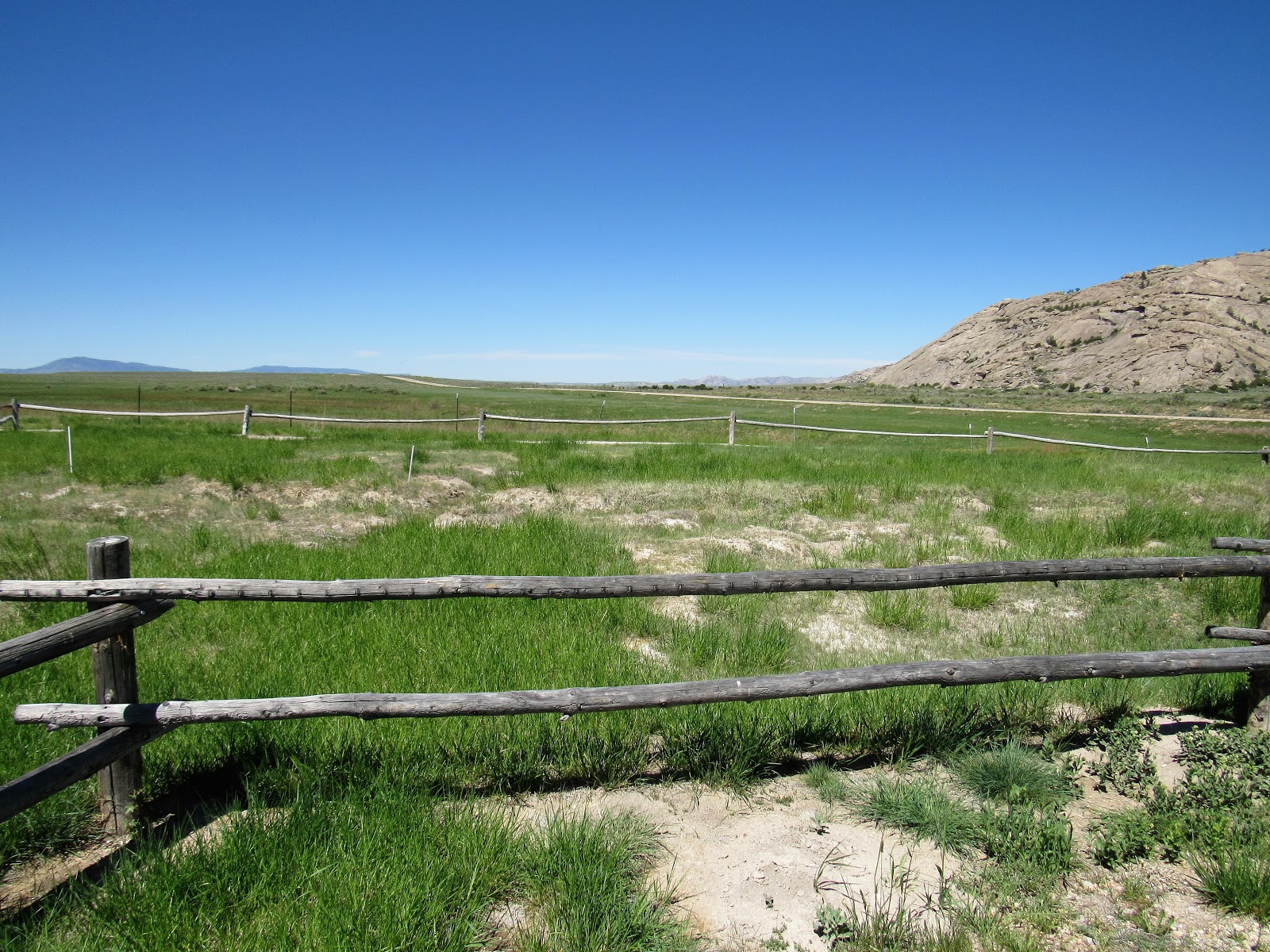
| Looking up the Sweetwater Valley from the original site of Seminoe's Fort. Martin's Cove is to the right. Split Rock can be seen in the far distance. |
Thursday, May 10, 2018
Likely Vaughan House in Cusop
Subscribe to:
Posts (Atom)